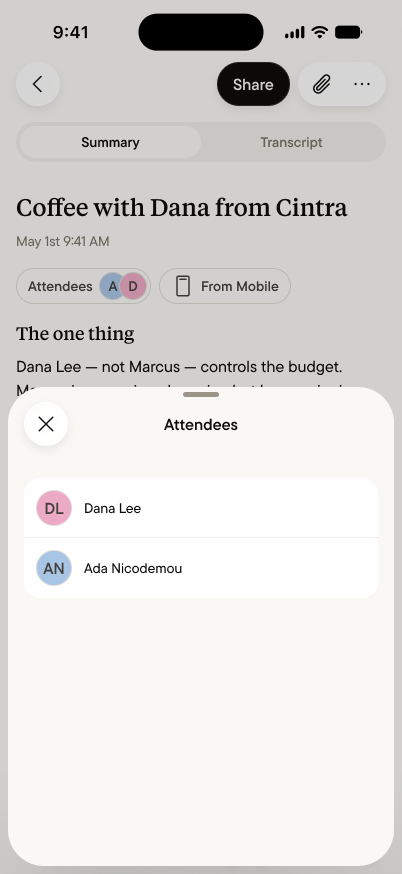
Every capture carries its attendees — the people who were part of the conversation, shown as chips on the Summary. They’re how your memory stays a memory of people, not just of words: who said the thing, who made the promise, who you keep meaning to follow up with.
Attendee chips on a Summary

Adding and correcting

Attendees are yours to set. Tap the chips on any Summary to add someone, correct a name, or remove someone who wasn’t really part of it — the same way you’d fix the attendee line in a meeting Summary. A first name is enough; add more when it’s useful (“Dana Lee, Cintra”). Corrections do double duty: speakers in the transcript are matched to the capture’s attendees, so fixing a name once fixes every turn they spoke.

The same person, across captures

Use the same name for the same person, and your captures connect: ask your personal agent about Dana, and it draws on every conversation Dana appears in — the coffee last week, the intro last month, the promise from yesterday. That’s how “who was there” becomes relationship memory: one name at a time, written by you.

What your agent does with them

Attendees are context your agents can use. “When did I last talk to Marcus?” “What has Dana said about pricing, across everything?” “Who did I meet at SaaStr?” — these questions work because attendees anchor conversations to people. The richer your attendee habit, the sharper the answers.

Private, like everything else

Attendees are part of the capture, and captures are private by default. Noting that you met Dana is your note, in your core, visible to no one — exactly as private as writing her name in a notebook, and exactly as shared as you choose to make it. If you share a capture to a Space, its attendees travel with it — that’s how “the team’s memory of the Cintra deal” knows who’s who.