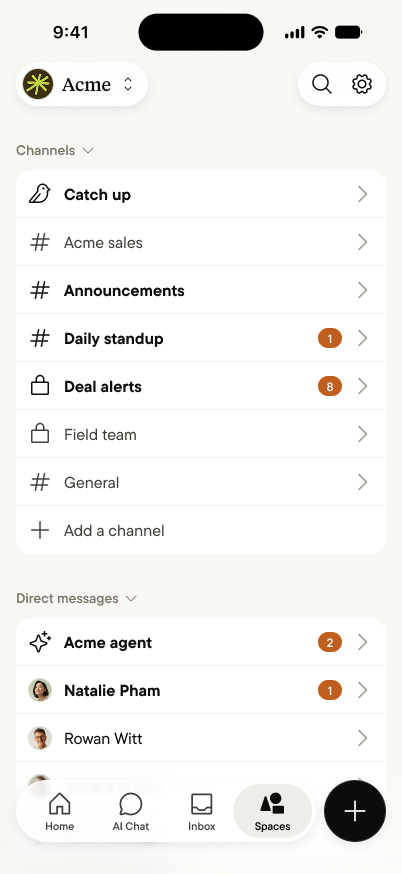
A space holds people; channels hold conversations. Each channel is a room inside the space with its own members and its own running discussion — by deal, by client, by project, however your group actually divides its attention.
A space's channel list, with regular and private channels, and direct messages below

Two kinds of rooms

Most channels are marked with a # — the shared rooms of the space, where the group’s working conversation happens. Channels marked with a lock are private: a smaller room, visible only to its members. A conversation’s audience is exactly the channel’s member list, and rooms you’re not in don’t advertise themselves. Need a new room? Add a channel sits at the bottom of the list — a channel is cheap to make and easy to name after the thing it’s for.

What lives in a channel

Channels are built from posts, replies, and reactions. A post can be written from scratch — or it can carry something better than prose: any capture from your Home can be shared into a channel as a post, so the room isn’t discussing your retelling of the conversation, it’s discussing the conversation. One channel per deal or per client works especially well: over time the channel becomes the running history of that relationship. Below the channels sit your direct messages — same space, room of two.

Channels and the space agent

What’s posted into a channel becomes part of what the space agent can draw on for that channel’s members. The agent’s rule is the space’s rule: it only speaks from what its audience could already see. Ask it about a deal, and the answer comes from the rooms you’re in — never from rooms you’re not.