> ## Documentation Index
> Fetch the complete documentation index at: https://docs.gobihq.com/llms.txt
> Use this file to discover all available pages before exploring further.
# Transcripts
> Every word, with speakers and playback.
Behind every Summary sits the transcript: the conversation
word-for-word, labeled by speaker, timestamped, with the audio one
tap away. The Summary is for living with; the transcript is for
the moments you need exactly what was said.
 ## Reading a transcript
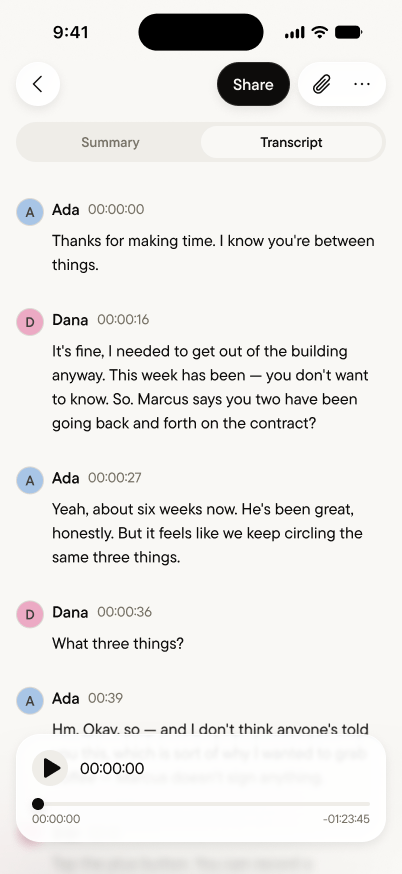
Each turn shows who spoke and when. Speakers are matched to the
capture's [attendees](/summary/attendees) — correct an attendee
once and their turns follow. Timestamps run from the start of the
capture, so a moment in the transcript is a moment you can jump
to.
During a capture, this same view runs live — the words appearing
as they're spoken. What you see mid-conversation is what you'll
find here after.
## Playback
Tap a moment to hear it. The player follows the transcript — skip
back ten seconds for the sentence you want to hear twice, slow it
down for the number someone said too fast. Reading tells you what
was said; hearing it back carries the tone.
## When to reach for it
Honestly: less often than you'd expect. The
[Summary](/summary/overview) carries the meaning, and
[your agent](/personal-core/personal-agent) answers most
"what did they say" questions with the receipts already attached.
The transcript earns its keep in the exact moments:
* **The precise quote.** When "roughly what she said" isn't
enough — a number, a commitment, the wording of an offer.
* **The disputed moment.** When memories differ, the transcript
settles it quietly.
* **The detail the Summary judged small.** Summaries choose what
matters; the transcript keeps what happened. Sometimes the
passing remark grows important later — it's still here.
## Honest edges
Real conversations are messy, and transcripts inherit it. Noisy
rooms, crosstalk, and people who've never said their names make
speaker labels less certain — a turn may occasionally land on the
wrong person or an unnamed one. The fixes are ordinary: correct
the attendees, and when it matters, tap play — the audio is the
ground truth the text stands on.
## Reading a transcript
Each turn shows who spoke and when. Speakers are matched to the
capture's [attendees](/summary/attendees) — correct an attendee
once and their turns follow. Timestamps run from the start of the
capture, so a moment in the transcript is a moment you can jump
to.
During a capture, this same view runs live — the words appearing
as they're spoken. What you see mid-conversation is what you'll
find here after.
## Playback
Tap a moment to hear it. The player follows the transcript — skip
back ten seconds for the sentence you want to hear twice, slow it
down for the number someone said too fast. Reading tells you what
was said; hearing it back carries the tone.
## When to reach for it
Honestly: less often than you'd expect. The
[Summary](/summary/overview) carries the meaning, and
[your agent](/personal-core/personal-agent) answers most
"what did they say" questions with the receipts already attached.
The transcript earns its keep in the exact moments:
* **The precise quote.** When "roughly what she said" isn't
enough — a number, a commitment, the wording of an offer.
* **The disputed moment.** When memories differ, the transcript
settles it quietly.
* **The detail the Summary judged small.** Summaries choose what
matters; the transcript keeps what happened. Sometimes the
passing remark grows important later — it's still here.
## Honest edges
Real conversations are messy, and transcripts inherit it. Noisy
rooms, crosstalk, and people who've never said their names make
speaker labels less certain — a turn may occasionally land on the
wrong person or an unnamed one. The fixes are ordinary: correct
the attendees, and when it matters, tap play — the audio is the
ground truth the text stands on.