> ## Documentation Index
> Fetch the complete documentation index at: https://docs.gobihq.com/llms.txt
> Use this file to discover all available pages before exploring further.
# Every capture becomes a Summary
> What a Summary contains and how to read one.
Stop a capture, and moments later it's a **Summary** — the
conversation understood, not just transcribed. This page walks
through one, top to bottom, so you know exactly what you're
looking at.
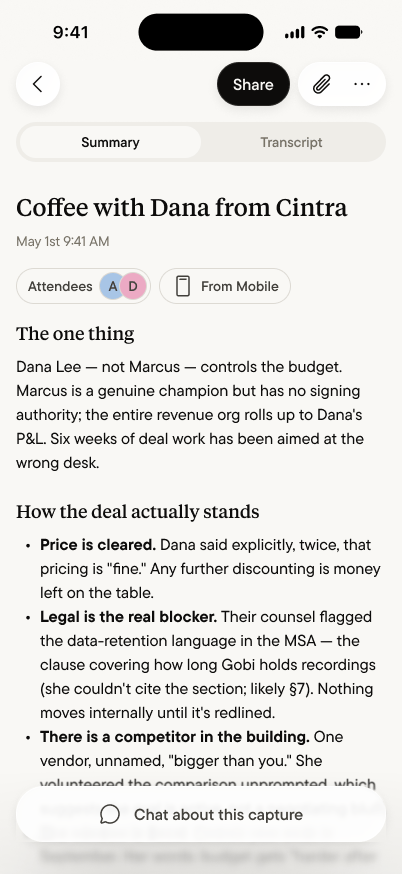 ## The header
Every Summary opens with what, when, and who: a title Gobi writes
from the conversation itself, the time it happened, and the
[attendees](/summary/attendees) — the people who were part of it,
shown as chips you can tap, correct, or add to. A small badge
notes where the capture came from.
## The one thing
The first section is the answer to "what actually mattered here?"
— one finding, stated plainly. Not a recap, a verdict: the budget
owner isn't who you thought, the timeline moved, the deal's real
blocker surfaced. If you read nothing else, read this.
## How things stand
The state of play, point by point: what's settled, what's blocked,
what changed. Each point leads with its conclusion in bold, so the
section scans in seconds and rewards a slower read with the
reasoning underneath.
## Worth noting
The subtext — what was said between the lines, hesitations worth
remembering, the thing that might matter in a month. This is the
section that separates understanding from transcription: a
transcript captures that words happened; this notices what they
meant.
## Next steps
What happens now, as a plain list: commitments made, follow-ups
owed, deadlines named. If you promised something in the
conversation, it's here waiting for you — which is precisely the
list your memory would have lost by evening.
## Your notes
The bottom of every Summary is [yours](/summary/your-notes): add
context Gobi couldn't hear, corrections, private judgments.
Your notes live alongside what Gobi wrote and travel with the
capture — your agent reads them too.
## And the transcript
Every word — who said what, when, with playback —
stays one tab away. [Transcripts](/summary/transcripts) are for
verification and quotes; the Summary is for living with. You'll
find you need the transcript less than you'd think.
***
A Summary isn't a document to file — it's memory in its useful
form. Read it once while it's fresh, add a note if something needs
one, [share it](/spaces/share-a-capture) if the team should know,
and let it sink into your core. When you need it again, you won't
go looking — you'll just [ask](/personal-core/personal-agent).
## The header
Every Summary opens with what, when, and who: a title Gobi writes
from the conversation itself, the time it happened, and the
[attendees](/summary/attendees) — the people who were part of it,
shown as chips you can tap, correct, or add to. A small badge
notes where the capture came from.
## The one thing
The first section is the answer to "what actually mattered here?"
— one finding, stated plainly. Not a recap, a verdict: the budget
owner isn't who you thought, the timeline moved, the deal's real
blocker surfaced. If you read nothing else, read this.
## How things stand
The state of play, point by point: what's settled, what's blocked,
what changed. Each point leads with its conclusion in bold, so the
section scans in seconds and rewards a slower read with the
reasoning underneath.
## Worth noting
The subtext — what was said between the lines, hesitations worth
remembering, the thing that might matter in a month. This is the
section that separates understanding from transcription: a
transcript captures that words happened; this notices what they
meant.
## Next steps
What happens now, as a plain list: commitments made, follow-ups
owed, deadlines named. If you promised something in the
conversation, it's here waiting for you — which is precisely the
list your memory would have lost by evening.
## Your notes
The bottom of every Summary is [yours](/summary/your-notes): add
context Gobi couldn't hear, corrections, private judgments.
Your notes live alongside what Gobi wrote and travel with the
capture — your agent reads them too.
## And the transcript
Every word — who said what, when, with playback —
stays one tab away. [Transcripts](/summary/transcripts) are for
verification and quotes; the Summary is for living with. You'll
find you need the transcript less than you'd think.
***
A Summary isn't a document to file — it's memory in its useful
form. Read it once while it's fresh, add a note if something needs
one, [share it](/spaces/share-a-capture) if the team should know,
and let it sink into your core. When you need it again, you won't
go looking — you'll just [ask](/personal-core/personal-agent).